What Skills Are Employers Looking for and How to Start Learning Them Today
Miami Tech Works Insights
When students ask what skills they should focus on next, the answer is in the data. Across thousands of job postings and workforce profiles, a handful of skills consistently appear — not just as technical requirements, but as the foundation of how work gets done in nearly every field.
Using Lightcast.io workforce data, we analyzed three major skill categories Technical, Software, and Common Skills to understand what employers are asking for, how those skills are evolving, and where students can focus their efforts to stay ahead.
Skills That Connect Across Career Paths
Some skills don’t belong to just one category, they appear in multiple areas, connecting business, technology, and communication roles. SQL, Python, and Microsoft Azure are great examples. These are the skills that bridge technical work with problem-solving and decision-making — and they’re showing up in almost every industry.

When a skill overlaps multiple categories, it becomes more versatile valuable to employers across different career paths. That’s what makes these “hybrid” skills the best starting point for students looking to future-proof their careers.
One shift that stands out is how Excel and Microsoft Office now appear under Common Skills. A decade ago, these tools were considered technical. Today, they’re as fundamental as communication or teamwork. Employers now view digital fluency as a baseline skill — something everyone is expected to know.
The takeaway: Mastering tools like Excel or Office is no longer enough. Students should build on them by learning automation, coding, and visualization tools that extend what those programs can do.
Fastest-Growing Skills in the Market
The next trend we observed is momentum — the skills showing the fastest growth in employer demand. At the top: Automation, Microsoft Azure, and Finance-related tech. All are expanding by more than 25%.
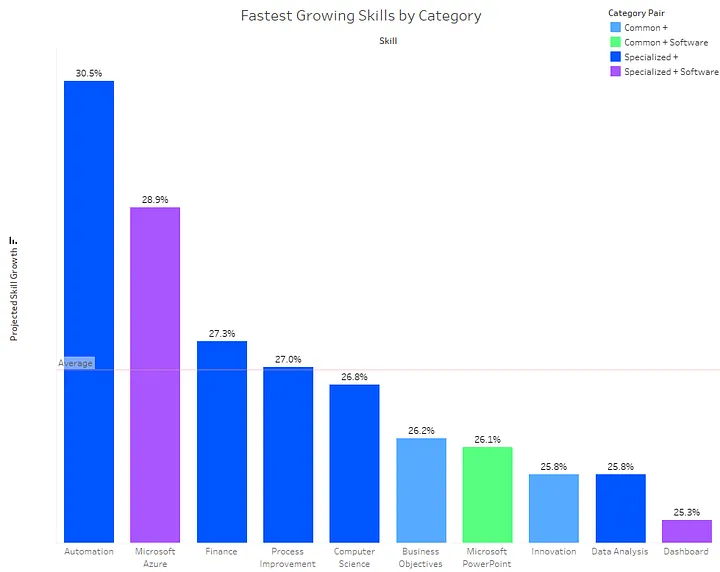
This pattern reflects a workforce that’s becoming increasingly connected through automation, cloud systems, and data-driven decision-making. Employers are looking for people who can not only use technology but also improve how it’s used.
Other fast-rising areas: Process Improvement, Innovation, and Data Analysis — reinforce this point. It’s not just about coding or IT; it’s about building systems that make organizations faster, smarter, and more adaptable.
The demand isn’t just for people who use technology — it’s for people who make technology better.
Hybrid Skills Following the Market Trend
When we compare job postings with workforce profiles, an encouraging pattern appears:
the skills that fall under multiple categories — such as Software + Specialized or Software + Common — tend to follow the market trend closely.
In other words, hybrid skills like Python, SQL, and Excel show a strong balance between what employers are asking for and what students are learning and listing.
That alignment suggests that students are building the right mix of skills — connecting technical knowledge with practical application.
Press enter or click to view image in full size
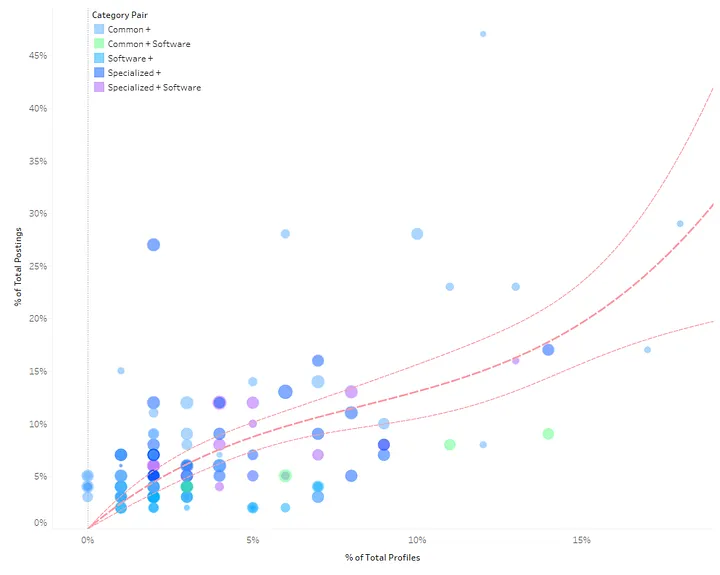
Meanwhile, soft skills like Communication remain essential, but they usually appear in only one category. This tells us that communication alone isn’t enough; pairing it with technical fluency is what drives real success in today’s workforce.
The takeaway: Skills that bridge categories, part technical, part applied are the ones keeping pace with market demand.
💡 Turning Data into Action
Here’s the good news: Many students already have the skills employers want, they just aren’t always showcasing them.
If you’ve built a website, app, or chatbot, you’ve practiced Computer Science. If you’ve used Excel macros, Python scripts, or automation tools to speed up a process, you’ve demonstrated Scalability. If you’ve built a dashboard or cleaned a dataset in Power BI or Tableau, you’ve already done Data Analysis and Visualization.
You don’t need a job title to prove your skills; Just make sure the projects you’ve done appear on your resume, LinkedIn, and professional portfolio.
Projects from class, internships, or personal interest count as real experience. The key is visibility: document them and describe what they accomplished.
For example:
- “Automated data entry using Excel macros to reduce manual time by 50%.”
- “Created a Power BI dashboard to visualize survey responses from 300 students.”
These small, concrete examples show real-world problem-solving skills which is exactly what employers want to see.
You already have the foundation. Now it’s about showing the world what you can do with it.
Where to Start
Here’s a practical roadmap to begin building — and highlighting — the skills that matter most.
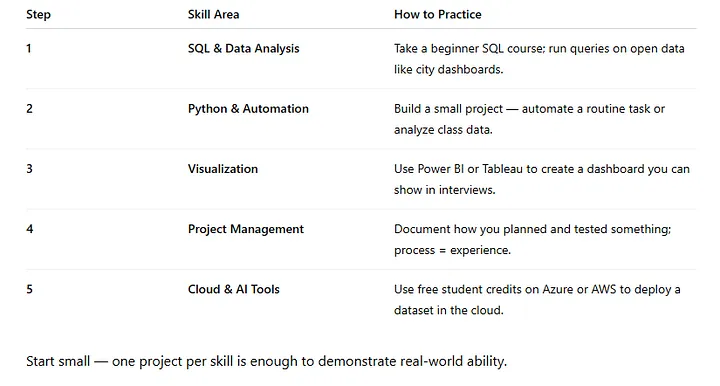
You don’t need advanced experience to start. Focus on one skill at a time and connect it to a real project or problem.
Key Takeaways
- Employers are looking for cross-functional talent — people who mix technical and communication skills.
- Excel and Office are now baseline literacy, not specialization.
- Automation, Cloud, and Data are core expectations for most career paths.
- Students who connect technical fluency with teamwork and problem-solving will stand out in every field.
Learn it. Apply it. List it.
Final Thoughts
The workforce is changing, and Miami Dade College students are in a strong position to meet that change. By developing skills that bridge multiple categories including SQL and Python to Azure and Power BI students can align their learning with where the market is headed. Every project, assignment, and collaboration is an opportunity to practice and prove the skills employers value most.
Show your work and make sure your skills are visible where employers are looking.
About This Analysis
Developed by the Miami Tech Works Analytics Team, using Lightcast.io labor-market data. Profiles represent workers of all education and experience levels. Our goal is to turn workforce data into clear, actionable insights that help students connect education to employment and prepare South Florida’s talent for the future of work.
Written by Ramon Castro, Database and Report Analyst.